If you’re a founder, an HR lead or an operations head who has just realised the people infrastructure isn’t keeping up with the company, this is for you. Not a theory piece. A guide to what you actually build, and in what order, so you don’t have to learn the sequence the expensive way.

The most common mistake is not building People Operations badly. It’s building it out of order – starting with automation before the data is clean, or rolling out self-service before anyone owns the process it’s meant to automate. The result is sophisticated tools sitting on a shaky foundation, and a team that has lost trust in both.

According to Deloitte’s 2024 Global Human Capital Trends report, 85% of business and HR leaders believe the way work is organized needs to change to better deliver both business and human outcomes. Yet many organizations continue to build People Operations out of sequence, introducing automation before establishing clean data, standardized processes, or clear ownership. The result is sophisticated tools resting on a fragile foundation, creating complexity instead of consistency and eroding trust in the very systems designed to support growth.

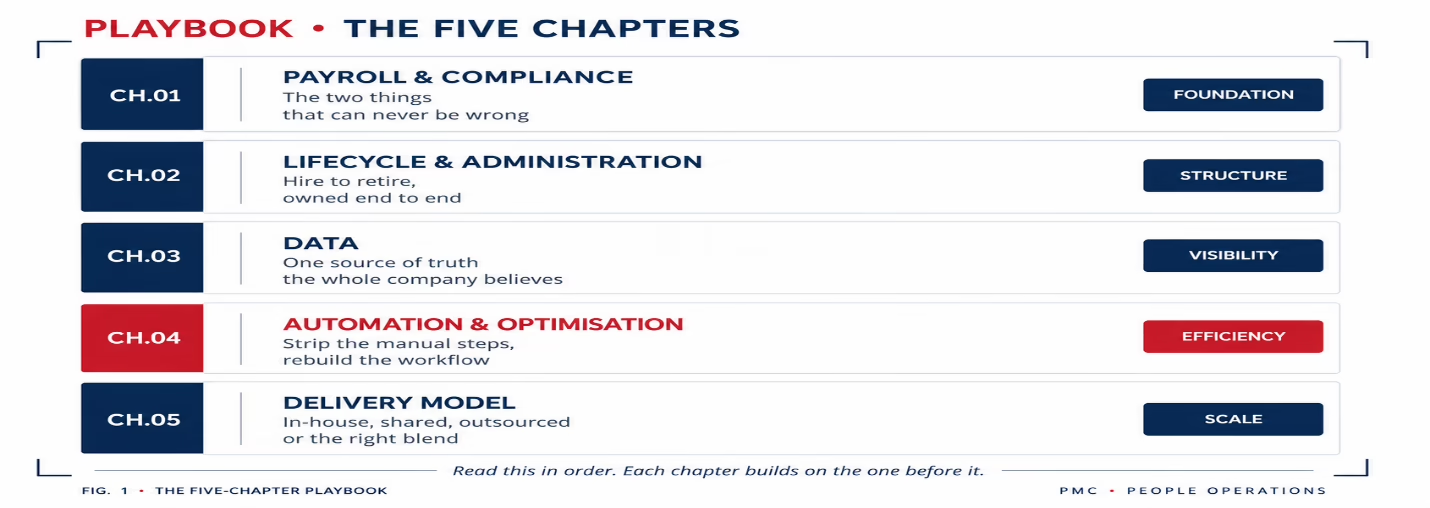
There are five chapters. Read them in sequence. Each one depends on the last.
Chapter 1 — Payroll and compliance: the foundation you pour first

Nothing else in People Operations survives if these two are wrong, so build them before anything else. This is not a sequencing preference. It's a structural requirement.

payroll management services means every person is paid correctly and on time - right amount, right account, right deductions, right statutory contributions - in every country where you operate. Payroll is the one promise a company makes to every employee every month in writing. People forgive a lot at work; a wrong payslip or a late payment is not typically on the list.HR compliance services sits alongside it: statutory filings, mandatory policies, proper grievance handling and the ability to face an audit without scrambling. Compliance requirements change constantly and differ in every jurisdiction. If you're operating in more than one country, they're not one job - they're multiple jobs running simultaneously. Build the infrastructure to run them that way.

One practical note: don't skip this chapter because you're small. The penalty for compliance failures is not calibrated to company size in most jurisdictions. It's calibrated to make sure it doesn't happen again.

Chapter 2 — Lifecycle and administration: one journey, owned end to end

Once payroll and compliance hold, build the employee journey. employee lifecycle management is the practice of treating each person's time with you - from offer letter to exit interview - as one connected, owned process rather than a series of handoffs between departments that nobody coordinates.

In practice this means: recruitment passes clearly to onboarding, which passes clearly to the employee's regular working life, which passes clearly - when the time comes - to offboarding. No one falls through the gap between one stage and the next.

The HR administration services that carry the journey need to be equally deliberate: records kept accurate and current, documents issued on time and correctly, policy letters that don't need re-sending, and questions answered before the person asking has to follow up. This is HR operational support in its most basic form - reliable, prompt, no-surprises. It is the largest driver of employee trust in the HR function, and it is almost always the most underfunded part of People Operations.

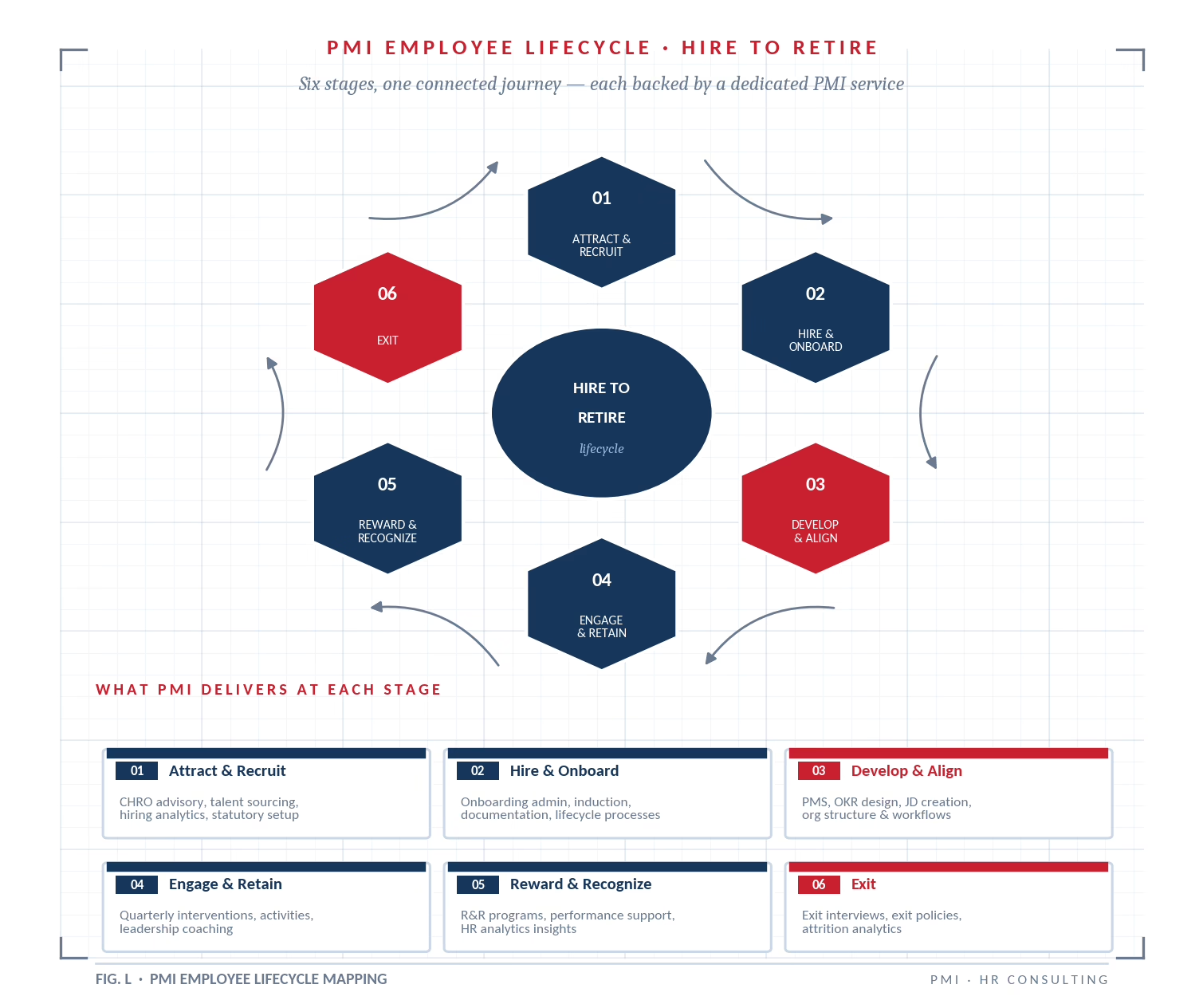
Map this chapter using PMI's hire-to-retire lifecycle - six stages, each with a defined owner and a defined service. There should be no stage without both.

Chapter 3 — Data: one source of truth that everyone believes

Now the data layer. employee data management means one accurate, secure, access-controlled record of your workforce - not a payroll system, an HR platform and a master spreadsheet that all disagree.

The test is simple: ask three of your systems how many employees you have. If you get three answers, you have a data problem. And the downstream cost of that problem compounds quickly: payroll reconciliations take longer, reports can't be trusted, audits become difficult, and every decision made using headcount data carries hidden uncertainty.

Fix this before you automate anything. Automation built on bad data produces bad outcomes faster. A clean, trusted single source changes the entire character of the function - suddenly reports mean something, decisions can be made on evidence, and the question “how many people do we have?” has one answer, immediately.

One practical note on access: the source of truth should be visible to exactly the right people and no one else. This is a compliance and privacy requirement, not a preference.

Chapter 4 — Automation and optimisation: now make it faster

Only here. Only after the first three chapters hold. Then, and only then, does automation pay off.

HR workflow automation removes the repetitive manual work: approvals, notifications, data entry, document generation. A leave request approved against a policy in seconds. A contract issued on acceptance without a person having to generate it. An onboarding checklist that triggers before the new joiner's start date, not after.

HR process optimization goes one level deeper: not just automating the existing process, but questioning whether the process makes sense. Why does this approval go to the founder? Why does this form require a signature? Why does this report take three hours to produce? Automation gives you speed. Optimisation gives you a process worth speeding up.

Together, they change the arithmetic of growth: a People Operations team can support a significantly larger workforce without growing in proportion. That gap, sustained over years, is one of the quietest competitive advantages a company can hold.

Chapter 5 — Delivery model: decide who runs each piece

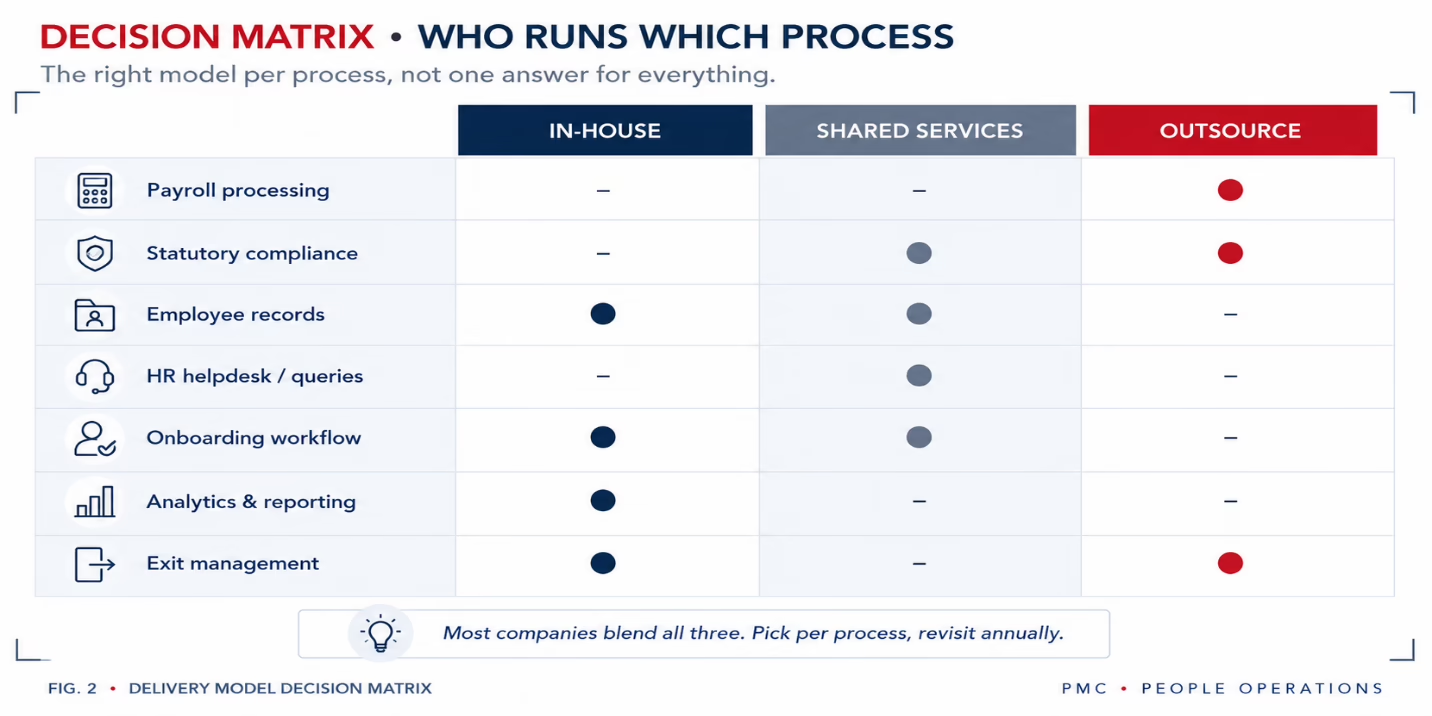
The last decision is structural: who runs People Operations, and how. There is no single right answer. There are three honest options, and most mature companies use a blend of all three.

Keep it in-house when the work requires deep context, cultural sensitivity or direct management of risk. Centralize into HR shared services when the same work needs to be delivered consistently across multiple sites or countries - one internal hub, one standard, one place employees go. Use HR operations outsourcing when a specialist can bring expertise, technology and scale that would take years to build internally. This is especially true for country-specific compliance, where the knowledge requirements are narrow, deep and constantly changing.

The human resource operational plan behind your delivery model should be explicit: which processes sit where, why, and at what service level. Hr strategy and operations are not separate tracks — the delivery model is a strategic choice that shapes the employee experience. And human resources and operations management is the discipline of keeping all three options working as one coordinated capability. In larger organisations this becomes a dedicated hr department operations structure, with clear leads for payroll, compliance, data and service. Operations management in HR, the broader field sometimes called human resource management operations — treats People Operations with the same rigour as any other business-critical function. Getting there usually starts with an hr operational plan that names owners and dates, and a clear view of how HR strategy and operations connect — strategy sets the direction, operations deliver it, and what the team learns feeds back into the plan. Which, once the company has more than a hundred people, it is. Good HR business operations decisions made here compound quietly for years.

A note on sequence

It bears repeating, because it’s the part most often skipped: the order matters. Chapter 4 built before Chapter 1 gives you fast, automated payroll errors. Chapter 5 designed before Chapter 3 means outsourcing a process you don’t fully understand. Chapter 2 skipped means your onboarding is the first week of someone’s experience of your company, and it’s whatever happens to happen.

The sequence is not arbitrary. It reflects the dependencies. Payroll and compliance are the foundation. Lifecycle is the structure built on it. Data is the visibility layer. Automation is efficiency applied to a clean system. The delivery model is the decision about who maintains it all. That order is the playbook.

How PMI helps

This playbook is how PMI’s People Operations practice works with clients. We bring deep HR operational expertise and experience across diverse companies – from startups building this for the first time to established enterprises redesigning it for scale. We start by identifying exactly where your current setup sits across these five chapters, find the gaps and the missequences, and build a roadmap that closes them in the right order. And it costs nothing to find out: the first few conversations are free, so there is no reason to hesitate.

Where PMC's People Operations service comes in

PMC’s People Operations service – part of our HR Consulting practice – covers this full playbook: payroll management services and benefits administration, hr compliance services and statutory support, employee lifecycle management, employee data management, HR shared services and HR workflow automation. We start with how your processes actually function in practice, not just on paper. We build leaner workflows around how your organisation really works, and we stay involved after launch – tracking, adjusting and refining as you scale. We don’t hand things over and disappear. That’s the whole point of calling it a practice.

About the Author

Mr. Anand Khot

HR Management Consulting Professional | OKR Implementation Specialist |
Organisational Development Expert

Mr. Anand Khot is an HR consulting expert specializing in People Operations, HR process transformation, HR technology, and organizational effectiveness. He helps organizations build scalable HR operations by streamlining processes, strengthening compliance, improving employee lifecycle management, and implementing technology-driven HR solutions. His practical approach enables businesses to create efficient, people-focused HR functions that support long-term growth.
AI Content Disclaimer:
This article was initially generated using AI-assisted content creation. It has been thoroughly reviewed, fact-checked, and edited by Mr. Anand Khot, who has refined and updated sections of the content to ensure technical accuracy, industry relevance, and alignment with best practices.

    Download Our Company Brochure